

Special Themed Residency Programs
 Applications are processed and selected in the order in which they are received.
 Arquetopia Location: Puebla, Mexico
Duration: 2 Weeks — Program Dates: Flexible, between March & July 2026
My First Arquetopia Residency is a 2-week introductory program designed exclusively for applicants ages 20 to 25 who are beginning, rethinking, or formalizing their artistic practice. It is conceived for emerging or first-time residents who wish to define or re-frame the foundations of their work through contextual immersion and guided observation. Rather than assuming that a practice is already formed, the program treats the act of beginning as a conceptual, ethical, and material problem: to locate where one is speaking from, to identify what one is reproducing or resisting, and to understand how one’s work participates in broader historical, social, and institutional narratives. Throughout the residency, participants move between close looking and collective discussion, between the museum and the street, and between archival knowledge and lived environments in Puebla, in order to sharpen their sense of intention, method, and responsibility within their future work.
Taking place in Puebla between March and July, the residency is intentionally scheduled during the academic recesses of the year —specifically spring break and summer break— to allow young students and early-stage practitioners to pursue an international residency experience in Mexico without interrupting their formal studies. Over the course of two weeks, participants engage closely with local museum collections, develop critical reflection through weekly meetings, and undertake structured field visits that situate artistic practice within broader social, historical, and material frameworks. This design enables students to experience a rigorously mentored residency abroad at a formative moment in their training, translating academic curiosity into lived, contextualized research outside the classroom.
Guided by one of these three thematic axes —gender, landscape, museums and collections— participants will work through a schedule that blends study, observation, and dialogue. The program includes guided visits to key institutional collections such as Museo Bello, Museo de la Revolución, Museo del Alfeñique, and the Biblioteca Palafoxiana, alongside different on-site visits that examine how place, power, and narrative intersect in public and institutional space.
Total hour activities include in-situ class (4 hours), individual mentoring sessions (2 hours), collection visits (4 hours), academic visits (5 hours), plus individual studio hours, offering a structured yet reflective framework for participants to articulate the conceptual, ethical, and methodological pillars of their work.
The strengths of the program lie in its active engagement with museum holdings, its critical pedagogical approach, and its focus on observation as an artistic and ethical method, providing a grounded, mentored point of departure for those beginning a sustained creative trajectory.
PROGRAM ACTIVITIES
Week 1
- Arrival and Mapping: Orientation and contextual mapping of the cultural ecosystem.
- Academic Visits: Guided explorations introducing historical and contemporary perspectives.
- Mentoring: Individualized sessions connecting practice to local knowledge.
- In-Situ Class: class conducted directly within a relevant historical or cultural site to learn from the context itself
- Collection Visits: Guided sessions inside museum or archival collections to observe, analyze, and contextualize objects in situ.
Week 2
- Studio Work: Time dedicated to advancing participants’ projects while engaging with critical perspectives.
- Academic Visits: Further contextual encounters with local institutions and knowledge bearers.
- Mentoring: Individualized sessions connecting practice to local knowledge.
- In-Situ Class: class conducted directly within a relevant historical or cultural site to learn from the context itself
- Collection Visits: Guided sessions inside museum or archival collections to observe, analyze, and contextualize objects in situ.
COMMUNITY COMPONENT
The Community Component runs across both weeks through direct encounters with the cultural ecosystem of Puebla — not only through formal institutions but through the people, spaces, and practices that animate them. Orientation and mapping ground participants in the living networks that sustain the city’s heritage; academic visits and in-situ classes place residents inside churches, archives, and historical sites where meaning is produced in relation to place; mentoring sessions introduce Arquetopia’s critical artistic methodology, linking this framework to what participants are encountering in context; and collection visits help participants to read museum and archival holdings as narratives of power and as technologies of seeing, not as neutral displays. Rather than treating community as an external category or outreach activity, the program stages community as an epistemic condition of practice: to learn is to enter a world already shaped by others.
Duration: 2 weeks
Minimum: 2 participants
Staff Support:
- Each resident artist meets weekly with our directorial and curatorial staff for personalized mentoring, research resources, project guidance, and critique.
Accommodation:
- Furnished, private bedroom
- 24-hour access to the kitchen for participants to prepare their own meals; meals/food are the participants' responsibility
- Wireless Internet
- Use of Arquetopia’s common spaces including outdoor terraces
- Shared, serviced (single) bathrooms with modern fixtures and showers
- Housekeeping
Studio Workspace:
- 24-hour access to large and bright, shared art studio with generous natural light
- Personal workspace with large table and wall space
DURATION / TIME PERIOD
Sessions are 2 weeks. Dates are not predetermined but are proposed by the applying artist.
Click here to apply for this instructional program.
2. IMMERSIVE LEARNING PROGRAM #1:
Day of the Dead: Speaking, Tasting, Creating
Arquetopia Location: Oaxaca, Mexico
Duration: 2 weeks – Program Dates:
October 26 to November 9, 2026
Why is the concept of death so integral to our understanding of collective experience? Across centuries, death has shaped social bonds, ritual knowledge, and the ways we process the fragility of life. In Mexico, the annual celebrations of Day of the Dead at the end of October and the beginning of November mark the closing of the maize cultivation cycle, and symbolically welcome the temporary return of deceased relatives and beloved individuals to Earth.
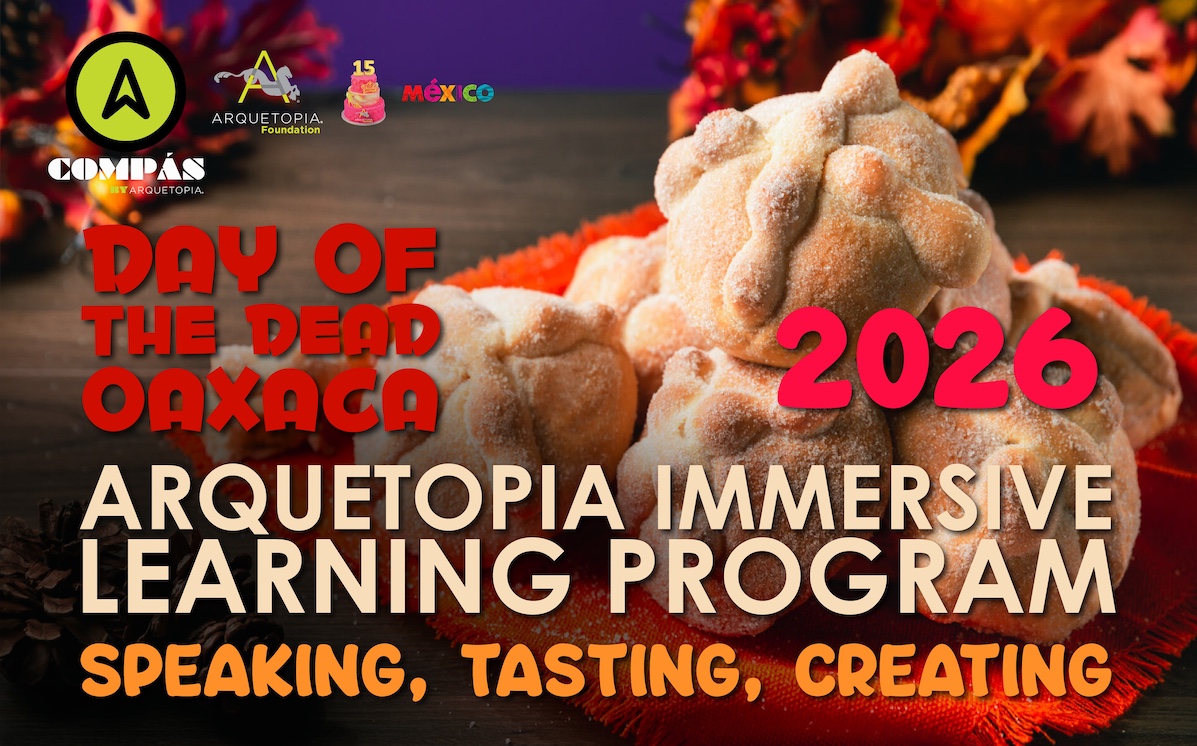
In Oaxaca, Day of the Dead is not only a commemorative act—it is a living dialogue between memory, food, land, and community. One of the most intimate dimensions of this celebration occurs in kitchens and communal ovens: the making of the Pan de Muerto, a Day of the Dead bread that combines ancestral knowledge, embodied technique, and symbolic language, where every gesture—from preparing the masa to tracing bone-shaped designs—carries memory.
The Immersive Learning Program: Day of the Dead focuses on the significance of Day of the Dead as a cornerstone of national identity rooted in Indigenous wisdom, tracing its influence on the development of Mexican modern art, and exploring its transformation into a secular and popular symbol. The program examines the performative nature of ritual, with special attention to mortuary celebrations and the relationship between food, offering, and remembrance. Within the context of this national holiday, participants will engage in practical Spanish language lessons, culinary exploration, and hands-on learning, fostering a multidisciplinary approach that integrates foodways, art creation, and linguistic practice. The program prompts critical inquiry into concepts of eternity, nationalism, and identity, questioning the use of death as a national symbol while unpacking its representation as a melancholic or morbid aspect of identity construction.
At the heart of the Oaxaca program is an embodied learning experience through the traditional preparation of Pan de Muerto. Participants will work alongside master bakers who pass on the knowledge of preparing dough, shaping symbolic forms, creating edible designs that evoke bones and tears (huesitos and lágrimas), and understanding the ingredients that anchor the bread to the land: milled wheat, native maize, anise, orange blossom, and the warmth of communal ovens. The process becomes an experimentation of sensory language—where aroma, texture, and form speak to a system of values around hospitality, absence, and remembrance. Through this perspective, food moves beyond sustenance and becomes a cultural document, a trace of cosmology shaped through flour, fire, and memory.
The Arquetopia Immersive Learning Program: Day of the Dead is a 2-week intensive experience designed to provide competitive professional opportunities for emerging and mid-career artists, curators, art historians, and students aged 20 and above from around the world. This distinctive program offers critical perspectives on the representation of death in Mexico as a foundational element of national identity. By examining the mythologies surrounding its origins and their reinterpretation over time, the program equips participants with analytical tools to understand the performative nature of Day of the Dead rituals, engaging with emotional portrayals, food as ephemeral art, material culture, and the evolving historical significance of death in the construction of identity. Participants will contextualize their own practices by learning bread making as a form of ephemeral art directly linked to the creation of ofrendas (altars), a central element of Day of the Dead celebrations in Oaxaca.
PROGRAM INCLUSIONS
This 2-week program includes 8 hours of instruction in ephemeral Day of the Dead culinary art techniques, including the preparation of Pan de Muerto, symbolic design elements, and the edible dimension of the altar. Participants will have the opportunity to join guided visits to traditional bakeries, communal ovens, markets, and local altars. Alongside these artistic and culinary endeavors, attendees will engage in 12 hours of Spanish language lessons, divided into 6 hours of grammar and 6 hours of immersive on-site language practice. They will embark on food tours (4 hours total) to explore the regional culinary landscape and spend 6 hours on academic visits to museums, cemeteries, and relevant cultural sites. Participants will also benefit from 2 hours of artistic mentoring sessions.
All activities are designed to promote intensive creative work and critical dialogue; therefore, participants are expected to dedicate self-directed hours to developing their artistic or research projects. Reading materials are provided in English, and workshop instruction is in Spanish.
- Each resident artist meets weekly with our directorial and curatorial staff for personalized mentoring, research assistance/resources, project guidance, and critique
- Furnished, private bedroom
- 24-hour access to the kitchen for participants to prepare their own meals; meals/food are the participants' responsibility
- Wireless Internet
- Use of Arquetopia’s common spaces
- Shared, serviced (single) bathrooms with modern fixtures and showers
- Housekeeping
- Downtown arrival pickup and departure dropoff transportation provided
- Affordable, everyday public transportation is available from the program vicinity into the city. Participants receive an orientation regarding the local transportation system upon arrival
Studio Workspace:
- 24-hour access to shared studio
- Personal workspace with large table
- Some tools provided
- Materials and supplies for the instructional course provided
- Materials and supplies for extended project production are not included but are available for purchase locally
DURATION / TIME PERIOD
Session is 2 weeks, October 26 to November 9, 2026.
PROGRAM TUITION INFO & APPLICATION DEADLINES
E-mail This email address is being protected from spambots. You need JavaScript enabled to view it. for tuition info and application deadlines for this program.
TO APPLY
Click here to apply for this instructional program.
3. IMMERSIVE LEARNING PROGRAM #2:
Botany and the Mapping of Ignorance
Arquetopia Location: Puebla, Mexico
Duration: 2 Weeks — Program Dates: Flexible
The knowledge of plants in the Americas, deeply rooted in non-dominant epistemologies, offering a different approach to the notions of wellbeing by putting an emphasis on the relationships we establish with the environment. Drawing on diverse knowledge systems and native practices, herbalists cultivate a profound understanding of the interconnectedness between humans and the natural world. However, the historical relationship between plants and “Empire” has left a complex legacy, marked by the exploitation of botanical resources by colonial powers for economic gain and geopolitical control. This exploitation has often led to the erasure or marginalization of autochthonous knowledge via the prioritization of pharmaceutical interests over plant-based remedies. Moreover, agnotology, the study of culturally induced ignorance, highlights how knowledge about plants and their properties have been manipulated or suppressed to serve political, economic, or ideological agendas. Arquetopia Immersive Learning Program navigates a space where the pursuit of holistic practices intersects with efforts to decolonize healing practices, notions of the body and challenge dominant capitalistic paradigms of knowledge production and dissemination. Through reclaiming and revitalizing ancestral wisdom, helps identify diverse sources of knowledge to aid in the promotion socio-environmental justice and fostering a deeper connection with the diversity of environments.
The Immersive Learning Program: Botany and the Mapping of Ignorance is a 2-week intensive experience designed to provide competitive professional opportunities for emerging and mid-career artists, curators, art historians, and students aged 20 and over, from around the world. This distinctive program offers critical perspectives on non-dominant epistemologies and the diverse uses of plants. By delving into the complex relationship between plants and "Empire" and its legacy of colonial exploitation of botanical resources for economic gain and geopolitical control, the program challenges the notion of "traditional knowledge" versus science. It scrutinizes this dichotomy as a system that centers exploitation through the erasure of indigenous knowledges, while also reevaluating the concept of "the natural" to understand relationships with ecosystems as a complex symbiotic network.
The objective of the program is to equip participants with the analytical tools necessary to understand the concept of interspecies kinship and the ethical questions related to life, while introducing them to the knowledge of local plants from Mexico, their historical significance, and their complex uses. Participants will also have the opportunity to contextualize their own artistic practices by learning about herbalism and the uses of native plants, which are central to understanding non-dominant epistemologies. Through this interdisciplinary approach, the program fosters a deeper understanding of the intersections between art, culture, and local knowledge, inviting participants to engage critically with their creative practices within broader socio-environmental contexts.
PROGRAM INCLUSIONS
This 2-week program encompasses a comprehensive structure aimed at enriching participants' understanding of herbalist techniques and local plant knowledge, including their historical significance, all approached through the lens of agnotology. Participants will engage in 8 hours of instructional sessions, complemented by guided tours and visits to prominent botanical gardens, markets, and local stores in Puebla.
In addition to these immersive learning experiences, attendees will partake in 12 hours of Spanish language instruction, comprising 6 hours of grammar and 6 hours of immersive on-site language practice. Cultural tours, totaling 4 hours, will provide further insights into the local flora, with academic visits to gardens, markets, and relevant sites. Furthermore, participants will benefit from 2 hours of artistic mentoring sessions tailored to their creative development.
Activities are thoughtfully designed to foster intense creative work and artistic dialogue, with participants expected to allocate self-directed studio hours as part of their weekly schedule. Reading materials are provided in English, while workshop instruction is conducted in Spanish, ensuring a rich and immersive learning experience for all involved.
- Each resident artist meets weekly with our directorial and curatorial staff for personalized mentoring, research assistance/resources, project guidance, and critique
- Furnished, private bedroom
- 24-hour access to the kitchen for participants to prepare their own meals; meals/food are the participants' responsibility
- Wireless Internet
- Use of Arquetopia’s common spaces including outdoor terraces
- Shared, serviced (single) bathrooms with modern fixtures and showers
- Housekeeping
- 24-hour access to large and bright, shared art studio with generous natural light
- Personal workspace with large table and wall space
- Some tools provided
- Materials and supplies for the instructional course provided
- Materials and supplies for extended project production are not included but are available for purchase locally
DURATION / TIME PERIOD
Sessions are 2 weeks. Dates are not predetermined but are proposed by the applying artist.
Click here to apply for this instructional program.
Unmaking Power, Remaking Worlds
Arquetopia Locations: Puebla, Mexico / Oaxaca, Mexico / Cusco, Peru
Duration: 2 Weeks — Program Dates: Flexible
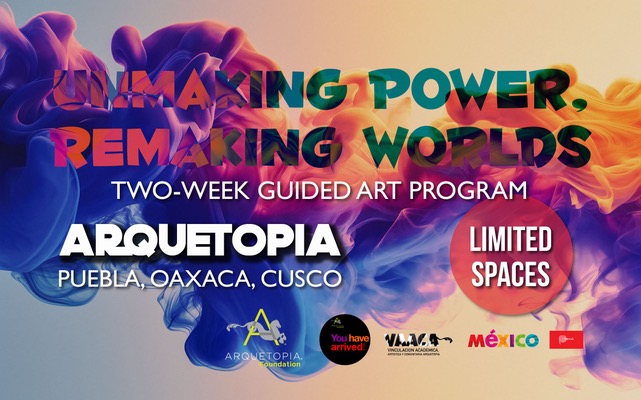
The theme of Unmaking Power, Remaking Worlds frames this two-week guided art program. It speaks to the process of critically dismantling inherited structures of power—those embedded in artistic practices, materials, and histories—while imagining and constructing new cultural possibilities. This theme guides the residency, inviting participants to reexamine their creative processes in relation to broader cultural and social dynamics, and to envision ways of inhabiting the world otherwise.
At Arquetopia, we conceive cultural ecosystems as living networks—dynamic spaces where culture, knowledge, and productive sectors intertwine critically and ethically. Culture is not limited to artistic creation; it is also about how we understand and share knowledge. It embodies the structures that have shaped technologies and ways of knowing, woven into daily practices and the productive life of communities.
This program is designed as an active cultural ecosystem where art, knowledge, and community practices intersect to foster new ways of thinking and creating. Rooted in situated knowledge, it emphasizes reciprocity and collective learning, inviting participants to recognize local knowledges as living technologies that shape how we inhabit and transform the world. By linking academic and community spaces, participants experience how culture not only sustains history but also becomes a force for social transformation.
Participants engage in academic visits, site-based mentoring, studio practice, and collaborative sessions with local institutions such as ARPA BUAP. The program integrates reflection and action, moving between guided research, direct encounters with the local context, and structured critical dialogue.
A central component is the Movilizatorio, an experiential format developed by Arquetopia. Here, participants walk through the city and its cultural fabric, transforming the territory itself into a classroom. The Movilizatorio connects cultural and productive sectors, activating knowledge in motion and highlighting everyday practices as sources of innovation, ethical reflection, and collective learning.
PROGRAM ACTIVITIES
Week 1
- Arrival and Mapping: Orientation and contextual mapping of the cultural ecosystem.
- Academic Visits: Guided explorations introducing historical and contemporary perspectives.
- On-Site Mentoring: Individualized sessions connecting practice to local knowledge.
- Movilizatorio: A dynamic, community-centered dialogue space activating cultural and social knowledge.
Week 2
- Studio Work: Time dedicated to advancing participants’ projects while engaging with critical perspectives.
- Academic Visits: Further contextual encounters with local institutions and knowledge bearers.
- On-Site Mentoring: Individualized sessions connecting practice to local knowledge.
- Movilizatorio: A dynamic, community-centered dialogue space activating cultural and social knowledge.
COMMUNITY COMPONENT
The program emphasizes not only individual artistic growth but also collective processes of learning. Through the Movilizatorio and the Open Process (PUEBLA ONLY) session with ARPA BUAP, participants engage in dialogue with local communities and institutions. These encounters encourage participants to rethink artistic practice in relation to broader cultural and social contexts, nurturing reciprocity and shared responsibility.
Duration: 2 weeks
Minimum: 2 participants
- Each resident artist meets weekly with our directorial and curatorial staff for personalized mentoring, research resources, project guidance, and critique.
Accommodation:
- Furnished, private bedroom
- 24-hour access to the kitchen for participants to prepare their own meals; meals/food are the participants' responsibility
- Wireless Internet
- Use of Arquetopia’s common spaces including outdoor terraces
- Shared, serviced (single) bathrooms with modern fixtures and showers
- Housekeeping
Studio Workspace:
- 24-hour access to large and bright, shared art studio with generous natural light
- Personal workspace with large table and wall space
DURATION / TIME PERIOD
Sessions are 2 weeks. Dates are not predetermined but are proposed by the applying artist.
Click here to apply for this instructional program.