
Missed the October 1 Deadline for 2027
and remaining spots in 2026?
E-mail Us at info@arquetopia.org
for Program Info, Application Materials, and an Extension
including Day of the Dead, and Short-Term Programs
Outstanding Arquetopia Alumni
R - U
Post-Residency Interviews and Feedback
Since its beginnings in 2009, Arquetopia Foundation has hosted and mentored more than 1,300 artists, writers, art historians, curators, and researchers, from ages 20 to 92, from 112 countries worldwide, and from a wide variety of disciplines. Featured here are testimonials and feedback from many of the most outstanding alumni of our award-winning residency programs.
What is your artistic practice?
I’m interested in the human body, and reproductions of it, as metaphoric sites for our experiences of the world. This interest has been heightened since the global pandemic where our bodies were both under threat, and at the same time a major source of resilience. Bodies appear in many of my paintings, prints and drawings, as I’m inspired by life models, mannequins, family, colleagues, and friends. I frequently draw from my own professional dance experience, especially regarding the visual aspects of body weight and movement.
I’m also curious about how botanical science has been a feature of colonisation, and the ways in which local knowledge about plants has been suppressed historically. I’ve been working towards a Certificate in Botanical Art at the New York Botanical Gardens since 2019, which I began when I was living in New York City. Watercolor, pencils, printmaking and pen and ink are important mediums in this type of work.
On what projects are you currently working?
There are two major themes that drive my practice. My first project for 2023 will question historical modes of the representation of women in visual art and is a direct outcome of my residency at Arquetopia, Oaxaca. My theory readings and discussions provided a catalyst for my ability to act, as my ideas were in embryonic form when I arrived. I’ve now started a collaboration with an experienced life model and together we’re coming up with scenarios that will drive my imagery for the rest of the year. Secondly, I’m always looking at plants and making studies as I try to work out how to visually depict some of the darker historical aspects of scientific collecting and categorisation.
What is the most relevant conversation that you remember having during your residency at Arquetopia?
One of the most relevant conversations I had with Francisco Guevara and Nayeli Hernández was about how visual culture contributes to collective views about people, places, and time periods. I began to understand that some aspects of art production contribute to power imbalances and have negative consequences for vulnerable people and environments. In my residency there was an emphasis on the importance of considering unconscious structures, biases, and motives behind the artist’s gaze. These discussions were underpinned by historical references as well as contemporary modes of disrupting such structures. The weekly meetings also helped me consider the shadow side of my own art production as my works go out into the world.
What changed after your residency at Arquetopia?
The main thing that has changed is that I’m acting on my intuition more independently, rather than waiting for validation from sources that may not understand my voice until it exists in visual form. In other words, I was able to take charge of my own direction and was emboldened to collaborate with a colleague to make my first painting studies from life. I began in January 2023 and find that things are beginning to consolidate and distill as I simply make a start.
How are artist residencies important to the artistic practice?
I think what makes Arquetopia’s instructed residencies very impactful on an artist’s development is the combination of theory with practice over a month-long period. So often art theory is disconnected from actual practice. On my residency, there was time to absorb the readings and discuss them with the other residents, as well as to learn practical and artistic skills from amazing local artists in Oaxaca. The individual tailoring to each resident is also crucial as this doesn’t always happen in larger academic institutions.
What is your artistic practice?
I work primarily with clay.
On what projects are you currently working?
I am currently continuing research that investigates questions that were brought up in conversations I had during my time in Puebla. I have dabbled into some video collaging and painting. I am hoping to depict and address the forced or fluid nature of a region with the use of soil and water through sculpting and performance projected onto an intentionally painted surface. A larger, long-term project I am working on is a mural design for the University of Texas, Rio Grande Valley. Alongside that, my time is spent working one on one with students at the university, where I currently attend and work.
What is the most relevant conversation that you remember having during your residency at Arquetopia?
The conversations I had with Francisco and Nayeli drastically changed the artistic direction I was taking. All of those moments we shared in Arquetopia allowed us to deconstruct my way of thinking. I was left to ask myself why I have chosen to address critical conversations in a creative process. Through our encounters I felt myself changing and rethinking all of my artistic ideas.
They were primarily interested in what I thought about the readings and the ideas that caught my attention. Did I agree or disagree with what I was reading? For the most part, I found myself to be very understanding of the readings, and I found them necessary. The readings spoke on injustices, and the responsibility of an artist. I always made sure to take notes of everything that was said during our meetings – everything spoken was important for me to fully grasp. I ended the residency with the question, What am I asking with my art, and who am I asking? Why is it important to me to have others assess these ideas? I continue to ask myself all these questions and share the types of discussions I had in Arquetopia with the community back home.
What changed after your residency at Arquetopia?
Every time a conversation is started, in my mind I refer back to those readings I tried really hard to understand at the residency. I now think critically about most interactions through this different set of lenses and ears as a result of my time spent there. My process does not end or begin at the touch of material anymore; it has become a day to day experience. Bueno, mas o menos.
How are artist residencies important to the artistic practice?
Residencies create a space where artists can explore their ideas in depth. Arquetopia specifically, provided access to text and in-person interactions among artists and mentors. Their ceramic residency in Puebla especially created the opportunity for international ceramicists to develop a great network with the community of creatives there in Puebla.
What is your artistic practice?
I am a sculptor working primarily in clay. Recently I have also begun to work in an installation and wall installation format, and to work with other materials such as wood and mirrors.
Conceptually, I am interested in exploring a conversation between interior and exterior worlds. I am drawn to containers and vessels, as they encapsulate, protect, preserve and metaphorically point to the coexistence of the universal and the individual. The human body as a functioning and conceptual container is also of interest to me. Working primarily through abstraction, I draw on our innate understanding of the language of form, referencing early life forms, basic biology, the natural world, and our physical and philosophical selves.
In addition to my work as an artist, I am an active curator in the Washington DC area, and serve as the Exhibitions Director and Curator at McLean Project for the Arts, a nonprofit visual art exhibition and educational organization in McLean, Virginia, where I put together exhibitions of work by contemporary artists from the Mid-Atlantic region of the USA.
On what projects are you currently working?
From April through October of 2018, I exhibited an outdoor sculpture in the Foggy Bottom Sculpture Biennial exhibition in Washington DC. In September through October my work was in a three-person curated exhibition at the Brentwood Arts Exchange in Mt. Rainier, Maryland titled “In A Fertile World”.
I am now preparing for a one-person exhibit at International Art and Artists at Hillyer, in Washington DC. The show will be titled “Quotidian Splendor” and will include mixed media sculpture, installation and wall pieces that celebrate and reflect on the nature of our everyday lives and ways of inhabiting the world, the resilience of the natural world, and the importance of preserving it.
What is the most relevant conversation that you remember having during your residency at Arquetopia?
I had to think hard about the best answer to this question, because I of course had many wonderful conversations during my residency with both the staff and my fellow residents.
But I think the MOST relevant conversation was an on-going, non-verbal conversation that took place in the Talavera factory during daily quiet working time there, across a Spanish/English language barrier. Although not a lot of words were exchanged between me and the Talavera artists working, there was curiosity, helpfulness and openness, and the familiarity that comes with the proximity of making things side by side. This felt both good and sometimes awkward and uncomfortable. Being in that position took me outside of myself in a way that was thought provoking. It’s good to get out of your comfort zone and inhabit an unfamiliar environment. It can give rise to some sense of new perspective.
The conversation that I had with the city of Puebla also turned out to be important to me. I spent a lot of time walking around that beautiful city, and the details of the architecture and the energy of the place were moving. I’m grateful to have had to opportunity to see it.
What changed after your residency at Arquetopia?
My work changed direction a bit as a result of my residency in Puebla, and although I didn’t make finished work there, I started a series of works which later developed into a series of nine wall sculptures called “Puebla Suite”. I brought the vessel format into my work, a direct result I am sure of spending time surrounded by Talavera pottery and incorporating the unfired ware directly into my work. Also, blue and white, once important to my practice, returned as a conceptual and visual underpinning. I also began to explore some of the structural elements of the of the Talavera ceramic tradition, such as the Niche and the reverential format of the Virgin of Guadalupe. So while my work remains personal in subject matter, the framework was expanded by my exposure to the visual culture of Puebla during the residency.
How are artist residencies important to the artistic practice?
Artist residencies are wonderful because they offer the gift of expansion. Traveling to a new place and focusing on making art while there, provides the unusual opportunity to have active creative time and new experiences and stimulation simultaneously. The seeds of artistic growth are planted, and although it can take time to see where they will lead, they will always lead into new territory if one is open to it. For an artist particularly, I believe it’s important to broaden one’s perspective. This will inevitably lead to stronger, more relevant and impactful art.
What is your artistic practice?
Photography, Stop-motion animation, film, video, and new media.
On what projects are you currently working?
Currently, I am working on a large array of photography for several magazine publications and independent artists. Most of my work is centered around spooky themes since it’s October, which is my favorite time of the month to make work. I have a big team of creative individuals and we shoot different concepts of mine for future publications. I am also putting together my applications for grad school, I am looking at getting a masters in Creative Photography and Experimental Media on the West Coast of the US. I’m also working on finishing some client videos such as commercials, wedding highlight reels and so much more!
What is the most relevant conversation that you remember having during your residency at Arquetopia?
My most relevant conversation was centered around the idea that photography is subjective. This was a known concept for me, but it really stuck at that moment because I realized my power in creating art. I think a lot of people assume photography is an easy medium where you’re simply capturing what exists already. However, this conversation made me see how untrue that is and how I am actually seeking out photographs to show off my perspective of the world. This is something that has stayed with me long passed the residency and now shifted the way I create art.
What changed after your residency at Arquetopia?
Arquetopia really helped me grow up in all definitions of the word. It helped me to be independent and find new found confidence in my work and my ability to be alone. Since returning home I am often struck with sudden bursts of mindfulness that was a gift from my residency in Peru. The approach to life there is much more calm and tranquil and that’s something I will carry with me for the rest of my life. I love to talk about my experience with friends and family, but I really can’t put it into words how life changing it was for me.
How are artist residencies important to the artistic practice?
Being a working artist is hard, because we’re balancing so many things. Running our own businesses and marketing and trying to get our work out there while trying to maintain a practice. It can really be hard to find time to create or think about your purpose while you’re trying to survive and make money to pay rent. When doing a residency all of these things are set aside and all you have to focus on is your art practice. That makes creating feel free again like it did when we were children. Creating, because it feels good to do so and you have the space for it.
What is your artistic practice?
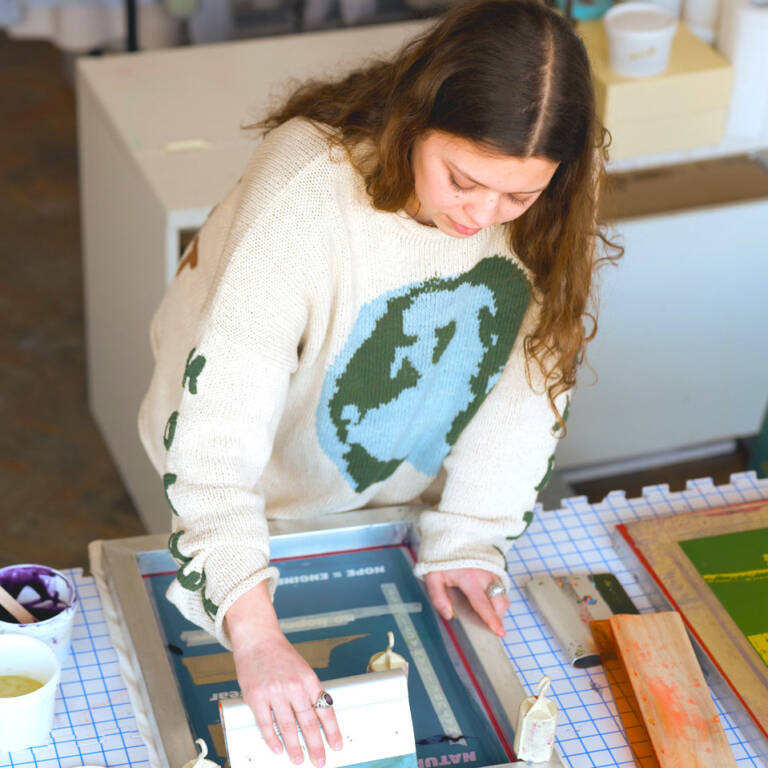
I am an interdisciplinary environmental researcher, storyteller and artist. My mixed-media textile artworks investigate how the arts can restore the broken human-nature relationship in order to tackle the climate crisis. I work with and for nature using a variety of textiles processes with a focus on natural dyes, silkscreen printing, knitting and stitching in combination with organic fibres, family heirlooms as well as discarded waste materials. I give the natural environment a voice by dreaming of a hopeful future where humans don’t deplete their ecosystems but heal them based on nature’s circular economy. I aim to set hope within the climate narrative to encourage and educate society so that humans and nature can return to living in balance on Earth.
What has been your artistic process during the residency?
At Arquetopia, I completed the natural ink silkscreen residency where I learned to extract pigments from plants, woods and grana cochinilla. I spend a lot of time learning about pigments from my incredibly knowledgeable teacher, Edgar. At the same time, I explored different symbolisms to talk about grief and healing through nature and textiles. My main focus was on how plants act as connectors between heaven and earth. This way I connected my research through my materials, process and tools.
Which has been the text, essay or quote that you read at Arquetopia that most influenced your practice and why?
There were a variety of insightful texts and conversations I held at Arquetopia, but one that was most poignant to me talked about “Text and Textile”, as it had me reflect on the connection between systems and textile making. It made me realise the connection between dying and dyeing. The plants I use to dye, need to die in order for me to use them to colour my fabrics. As my project dealt with grief and healing trough nature, this quote specifically helped me connect different components and influences in my practice.
What is next in your artistic practice after the residency?
The residency left me inspired and full of ideas. I want to continue extracting pigments and work with natural dyes to make textile artworks that talk about hope in the climate narrative. I feel inspired to continue building communities of care, to share and exchange knowledge and skills to open up challenging conversations that lead us to find solutions in the climate discourse.
What is your artistic practice?
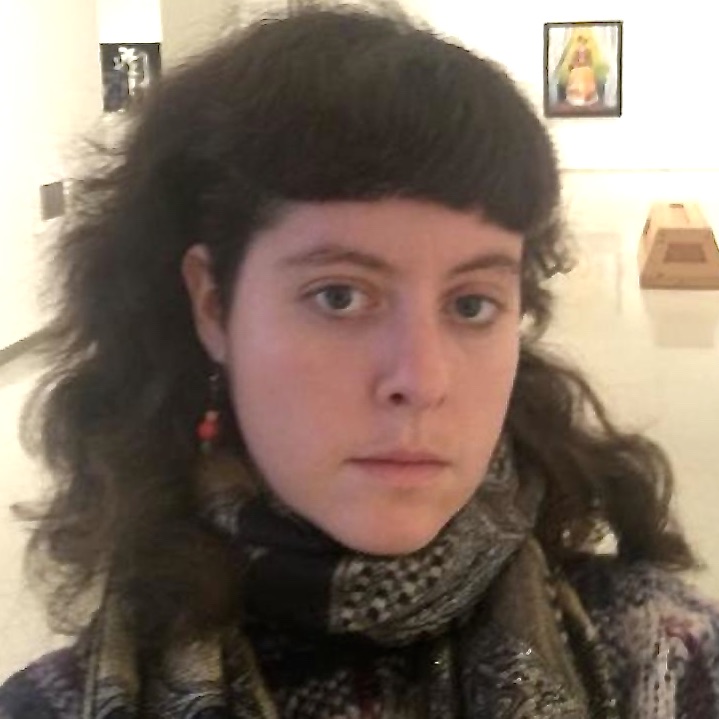
I define my artistic practice as waking up within a dream. I was raised in a family of artists. My mom and brother are both painters and my dad is a writer, so such creative activity has always been engrained in my daily life. I have dabbled in many mediums, always guided by bright colors and big questions.
On what projects are you currently working?
I use art making as an opportunity to explore the implications of living in a dream world. My practice is above all about remembering the incorporeal nature of my being, and living according to that recognition. I aim to express the inherent unity I sense in this reality. In a dream there is no distinction between subjects. They are all projections of the same mind, a unified consciousness peering out at it self from seemingly separate bodies.
What is the most relevant conversation that you remember having during your residency at Arquetopia?
Francisco would often refer to history and place as a distortion of time and space. He shared the idea that the only moment lived out side of colonization is the present encounter between subjects. As artists our creations are encounters with subjects that happen outside of time. Through our work we have the opportunity to create another filter of distortion that attempts to correct the first two. If we are not conscious of the shadow implications of our work, we will inevitably perpetuate the destructive distortions of history and place.
What changed after your residency at Arquetopia?
For me, the residency was a moment to pause and re-evaluate what it means to be an artist, and the impact I am liable of making on the world. I feel a new sense of responsibility and commitment to creating in a way that questions and disrupts dominant narratives. The residency imparts an obligation to strive towards an ever less destructive and more informed practice of making.
How are artist residencies important to the artistic practice?
I was able to secure a grant through the Greater Pittsburgh Arts Council that funded my residency. I think the most important part of the whole experience for me was realizing I was empowered to create such a dreamy scenario for my self. The excitement of having people read about my ideas and see potential in them, enough to provide me with the space, time and resources to work. It gives me a new sense of possibility. That empowerment is something I can hold with me and move forward with. Truly living the dream.
What is your artistic practice?
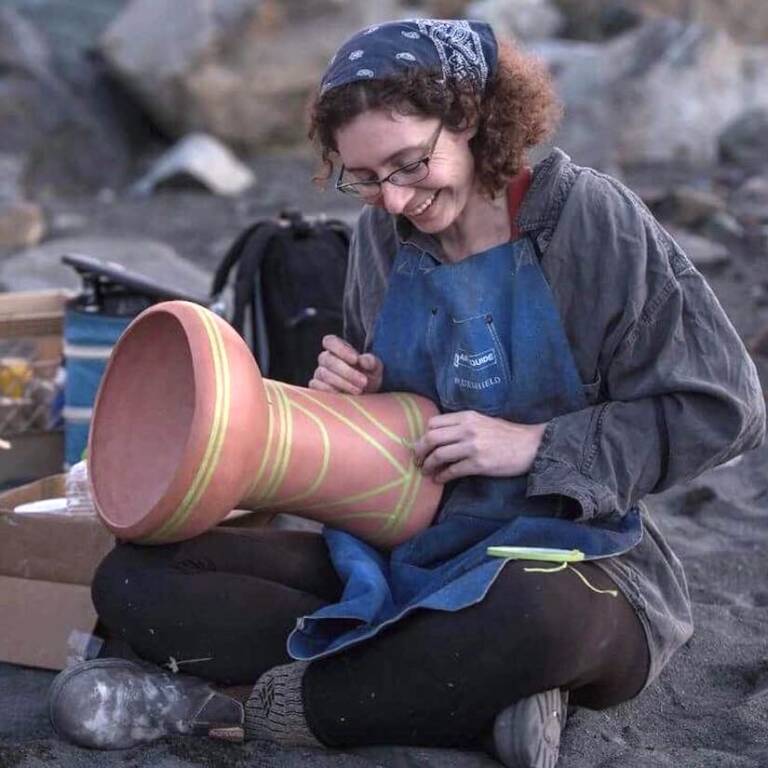
I am a ceramic artist based in St. John’s, Newfoundland, Canada. My work is divided between functional pottery and one of a kind conceptual pieces.
On what projects are you currently working?
I am currently working on a collection of handmade ceramic musical instruments that will be featured in the upcoming group exhibition ‘Instrumental’ that will be held here in St. John’s at the Craft Council Main Gallery.
What is the most relevant conversation that you remember having during your residency at Arquetopia?
This is very difficult to narrow down to just one. All of the dialogues I had with Franscisco and Nayeli were incredibly useful and engaging, particularly those focusing on the issues of feminism in art. Probably the conversation that stands out the most would be the discussion about Audre Lourde’s “The Master’s Tools Will Never Dismantle the Master’s House.” The issue of how to have an authentic voice as a woman in a male focused society without relying on the same tools used by that society is of particular interest to me and remains a significant challenge.
What changed after your residency at Arquetopia?
The residency at Arquetopia help me realize how much I was missing critical dialogue from my artistic practice. This recognition has actually motivated me to apply to a number of grad schools for this fall.
How are artist residencies important to the artistic practice?
I think the greatest value of artist residencies lies in the opportunities to work alongside artists from all different backgrounds and disciplines. The conversations and inspirations had with the other resident artists helped me to see my own work with fresh eyes, and to gain a greater appreciation for the work being created by my contemporaries. The cultural immersion is also significant to an artistic practice because it reawakens one to the world and offers new and exciting perspectives.
What is your artistic practice?
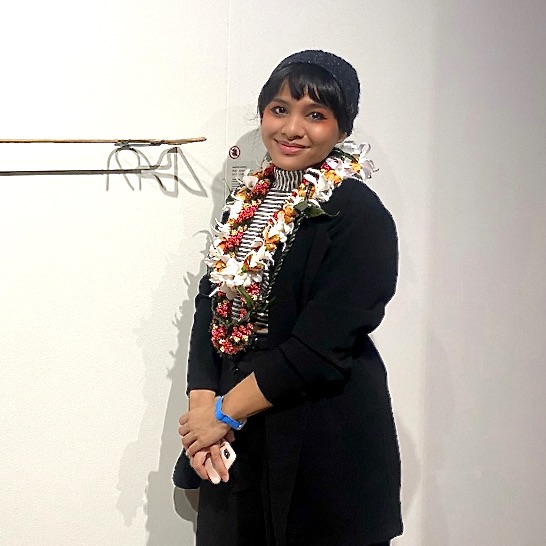
I’m a sculptor working predominantly in metals and fiber, creating objects and installations. My work subverts and utilizes object languages to speak to issues regarding intimacy, labor, and women’s positionality within the patriarchal system.
On what projects are you currently working?
The projects I’m developing are extensions of work regarding the ways a woman’s body and identity may be weaponized, addressing themes of gender, racial, and social inequities. Technical processes explored are craft-oriented, considering labor and process as meditative actions that unpack histories of abuse and injustice. The mixture of metal and fiber in my work play on the dynamics between hard and soft and the assumptions of strength and fragility attributed. Technical processes include bead weaving, sewing, metalsmithing, enameling, and traditional throw-net sewing. These projects are meant to exhibit in two upcoming solo exhibitions in Boulder, Colorado, USA and Kyoto, Japan.
What is the most relevant conversation that you remember having during your residency at Arquetopia?
We discussed Audre Lorde’s “Uses of Anger” and Linda Bolton’s “Facing the Other”, regarding the problem of the universal, and to confront the reality of our differences to combat our erasure.
What changed after your residency at Arquetopia?
The readings and discussions I had during this residency provided some tools and approaches for mitigating and navigating critical discourse among my students. Learning techniques on the backstrap loom was an absolute privilege, and I am continuing to learn new weaving techniques both on and off the loom to explore aspects of labor and material processes connected to culture and gender performance.
How are artist residencies important to the artistic practice?
I always find the conversations I have in these settings where you get to meet a variety of people at different places in their career have always stuck with me more than any technique or class. I can make art in any room with some tools and a flat surface; that’s not the point of a residency to me. It’s human connection, and the dedicated time and space of a residency that allow for contemplation, research, conversation, and exchange that create new understandings and new confusions.
What is your artistic practice?
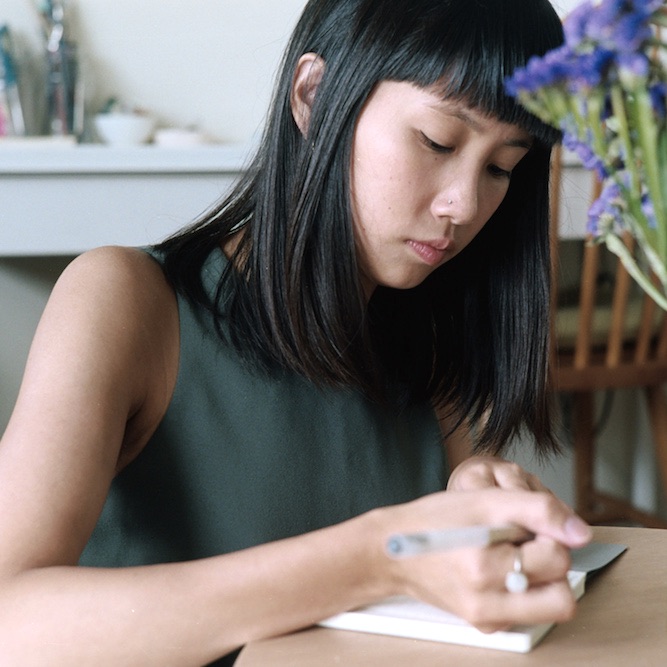
I’m a multifaceted graphic designer.
On what projects are you currently working?
currently working on an immersive show at my apartment, a night of music, art and performance. Reflections is the theme of the show, in the physical and abstract sense.
The physical reflection is created through calming video projections, made from recording the light bouncing off the experimentation of reflective objects. Abstract reflection is addressed during one’s self reflection during the musical performance and the meditative intermission.
The symbol of the moon, through it’s light and shape will tie all the elements of the show together. As the moon’s visibility is made possible by the reflection of the sun’s light.
Another project I am working on is a documentary film series about one’s relationship with their home and the routines that arise from being in their space. Home can be thought of as the extension of one’s personality, and I hope to capture that.
What is the most relevant conversation that you remember having during your residency at Arquetopia?
I’ve had countless interesting, challenging conversations at Arquetopia with Francisco. I started the residency, thinking that I would create a piece that was universal, which could be understood by anyone. That’s impossible, I learned, as everything is relative and everyone’s experiences are different. The idea that no one could be closer and more different to you than your mother, shows this thinking. We can relate to one another but that doesn’t mean that we understand each other. No two people will ever experience the same thing in their minds. It’s with the friction from these differences that causes new ideas to form. To be less universal, be more specific. I understood that your own experiences can take on another dimension profound to you, and that in itself is valid.
Another important idea was to think about your work as an open ended question. Changing the statement into a question allows the piece to stand the test of time as it can adapt to different contexts. As Francisco mentions, these questions enforced with your artistic technique transforms intention into agency.hey were all relevant! I think the best aspect of the conversations was getting a range of answers about the history of Puebla and cultural vagaries that helped me to start developing an understanding of the area and history.
What changed after your residency at Arquetopia?
As an artist, I have pushed myself in directions that I didn’t know I was capable of arriving at. I’ve become more critical and have embraced the process much more, instilling confidence and excitement in me to keep pushing through to create.
How are artist residencies important to the artistic practice?
Artist residencies allow for us to have all the desirable elements for fostering learning, embracing the process and pushing beyond what we thought we were capable of. It’s important for creatives to be able to dedicate the time, whether it be a week, a month, or a year to be able to focus solely on investigating what they care about inwardly and outwardly. It is by stepping away from the comfort of your own routines, that you are able to change your perspective to make something profound for yourself and possibly others.
Anna
Stuffelbeam
USA
Visual Artist — Textiles
Artist Website
What is your artistic practice?
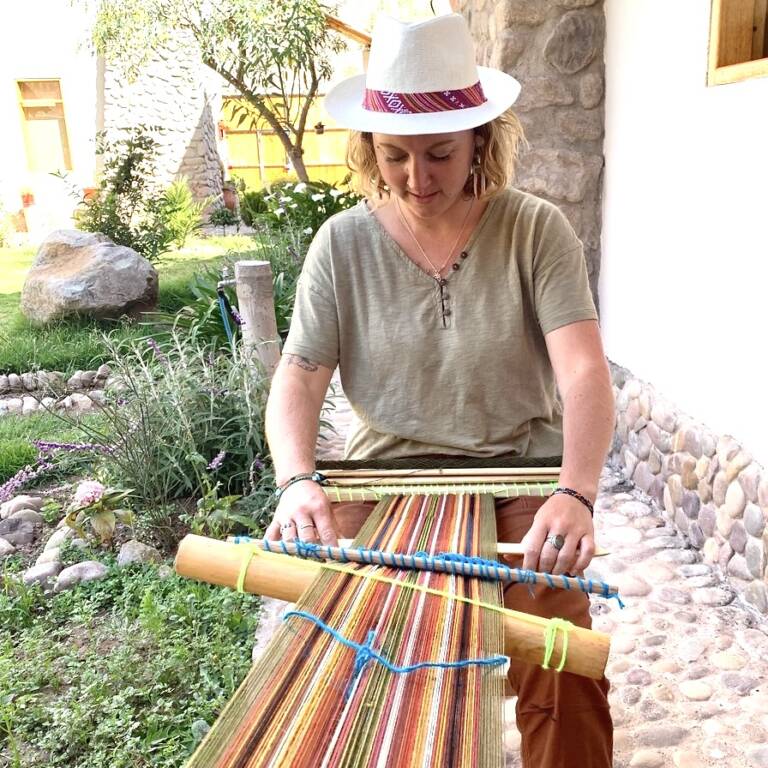
I work with natural pigments and fibers to create usable textiles and art pieces. For me it is about the experience of working with the materials and knowing the whole story of where they come from, participating in the process of transformation from raw wool and plant pigments to woven works of imagery and wearable fabrics. It is a process and shared experience. The imagery and textures are inspired by experiences in nature and my photography capturing those moments.
What has been your artistic process during the residency?
During the residency I was focused on learning from the experience and documenting the process through a series of mini woven and knit samples and a sample book of colors. During the three weeks focused on Andean weaving, I worked on weaving samples exploring different techniques and ideas inspired by experiences throughout the residency. I also expanded on the sample idea through knitting a mini sample in the same color sequence but with different textures. For the three weeks focused on Natural Pigments I worked on documenting every plant and every color we created. Using the dye bath I painted plant portraits and took color samples on paper and fabric along with the yarn. I developed a more thorough and consistent practice of documenting and keeping track of the colors and the process of using natural pigments. This residency gave me the opportunity to really develop my practice and realize it is the whole experience of the process that I am passionate about, not just the end product. It was truly a gift to have time dedicated to experiencing my process, allowing for change and discovery.
Which has been the text, essay or quote that you read at Arquetopia that most influenced your practice and why?
Many readings influenced a shift in my perspective of society, the art world and my work within these structures and sparked my questioning what narrative I want to be a part of:
1) The Structure of Knowledge in Westernized Universities Epistemic Racism/Sexism and the Four Genocides/Epistemicides of the Long 16th Century – Ramón Grosfoguel
2) Imagined Communities Reflections on the Origin and Spread of Nationalism, – Benedict Anderson
3) Landscape and Power – W.T.J. Mitchell
4) Racecraft, The Soul of Inequality in American Life – Karen E. Fields and Barbara J. Fields
What is next in your artistic practice after the residency?
There were many wonderful discussions that helped broaden my perspective and question ideas about belonging to a specific culture or distinct identity and what it means to be qualified to teach a skill. I have felt called to teach and share my passion for creating with textiles, but have been hesitant, like I am waiting for permission. These readings, discussions and this experience has helped me let go of that hesitation allowing me to take this next step into sharing my practice.
Thank you for all your support throughout this experience. I really appreciate how we were all well cared for and welcomed into the Arquetopia experience.
What is your artistic practice?
I am a jewelrymaker and artist.
On what projects are you currently working?
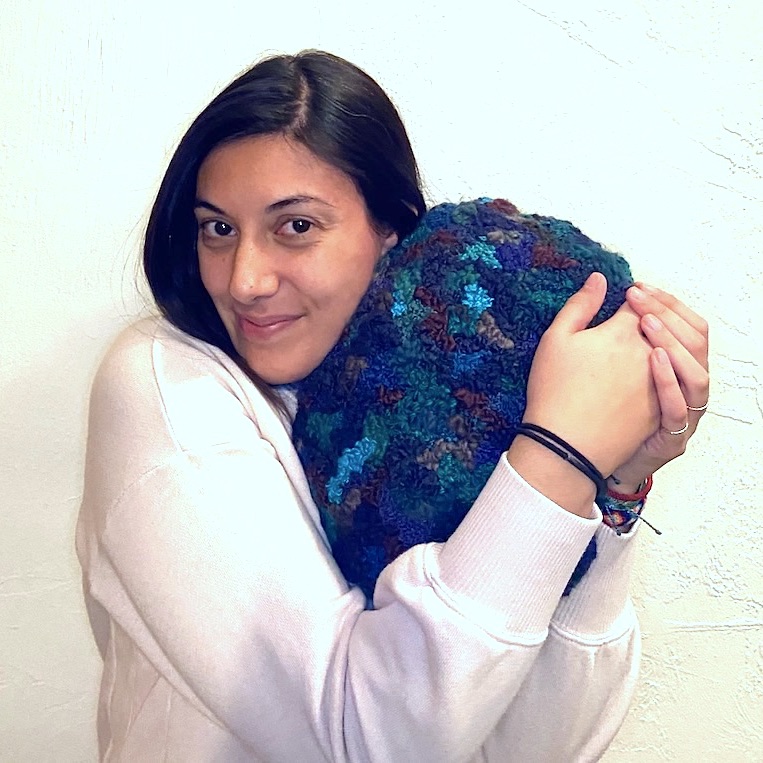
I am currently working on a few different projects. When I came back from Peru, I wanted to work on a project just for fun, so I decided on weaving custom pillows. Along with that side project I have being doing experiments and research for a new jewelry collection focusing on the concept of the mind and racing thoughts.
What is the most relevant conversation that you remember having during your residency at Arquetopia?
The most relevant conversation I had was talking about how art is viewed and how the opinion of the viewer continues to change and evolve over time do to the continuous change in our world and society. It was eye opening for me to realize the meaning of a piece will continue to change over time as societal norms continue to change. I learned it is important to understand how other people see and view your work because even if you have a concept for your work it might not translate to the viewer especially one with a different background.
What changed after your residency at Arquetopia?
Before my residency I would have an idea and a plan out what I was going to make and what materials I was going to use. During my time at the residency I learned from master weaver Maria that you cannot always force materials to work with a technique. Rather you must find harmony between your materials and techniques.
How are artist residencies important to the artistic practice?
Artist residencies are an important part to any artist’s practice. As an artist you much be committed to the continuation of learning; not only learning new techniques, but learning about oneself. I believe that artists need to keep exploring and expanding their knowledge in order to keep making relevant work. Artist residencies give artists the opportunity to continue to grow in a safe and supportive environment.
Monserrat
Tlahuel-Flores
USA
Visual Artist — Ceramics
Artist Website
What is your artistic practice?
Ceramics.
What has been your artistic process during the residency?
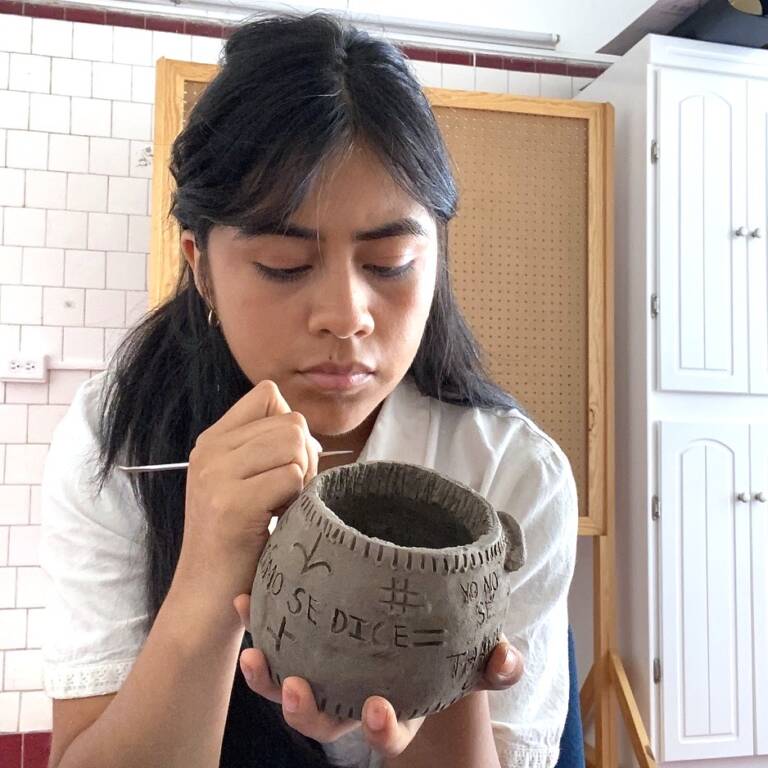
My artistic process during the residency was definitely something unexpected. I was inspired by the conversations I had with the directors, my teachers, and many different museums with pieces that I would have only been able to experience in person. I took little crumbs of other ceramics pieces I saw, feelings I had, conversations that touched me and different experiences in my past. I focused on the portrayal of different emotions through facial expressions all throughout my pieces because as an artist, at times, it feels as if the only way to express pent up emotions is by creating. Weather it be through tears, late at night at the studio or watching movies and singing to songs at 1:00 AM as you work, each and every piece expresses something distinct and memorable.
Which has been the text, essay or quote that you read at Arquetopia that most influenced your practice and why?
Throughout my residency, I was given the opportunity to read about an array of topics ranging from the feminist movement to toxic tourism culture. Through these many impactful and fascinating reading the one that stood out to me the most was a reading titled, “The Uses of Anger” by Audre Lorde. This text has stuck with me, and I have been able to share with my friends and family who have also gone through racial prejudice. This text as a whole truly spoke to me because as a woman, anger is an “ugly” emotion to have. I was taught to believe that anger is what you feel when you are bitter, resentful, and unable to move forward. I was conditioned into believing that my anger towards my own experiences with racial prejudice was a sign of my own lack of strength as a proud Mexican woman. This text not only expressed everything that I had been feeling for many years but embraced anger and all of its “ugliness”. Lorde quotes, “Anger is an appropriate reaction to racist attitudes, as is fury when the actions arising from those attitudes do not change”. I used these ideas, and feelings I had in creating my piece, titled, ANGRY.
What is next in your artistic practice after the residency?
After my residency, I am planning on continuing my understanding of the beautiful elements of natural clay making. I plan on continuing on the path of discovery by honing in on my skills by taking more ceramics classes, focusing on different techniques with the utilization of the wheel. I also plan on making a short film inspired by my pieces and taking what I have learned into different mediums.
What is your artistic practice?
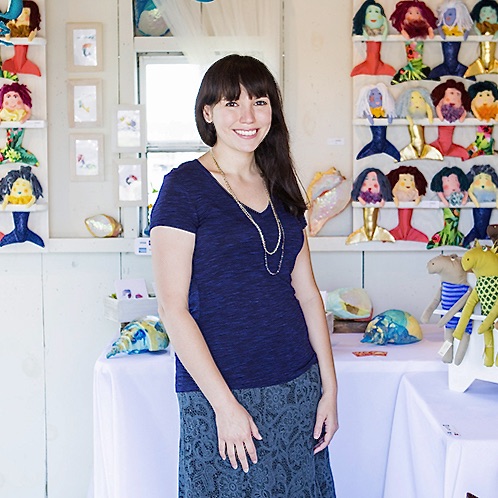
I am a visual artist working primarily in painting and sculpture. I draw inspiration from the tangible process of artmaking by learning the traditions and histories of the mediums themselves. My own practice explores decorative objects and realistic subjects that also have inherent layers of meaning. I seek to establish a new narrative in my art while fostering a connection to artists and craftspeople who have come before me.
I am currently working on miniatures crafted from spun cotton and inspired by techniques used in 19th-century Germany. Researching this project has been a fascinating look into a cottage industry that produced some beautiful surviving figures but left few details behind of their process.
I am also painting a series of landscapes on Cape Cod (Massachusetts, USA). Cape Cod has been attracting plein air artists for over a century and I am considering it a challenge to show my own vision of my home through painting.
On what projects are you currently working?
I am currently working on miniatures crafted from spun cotton and inspired by techniques used in 19th-century Germany. Researching this project has been a fascinating look into a cottage industry that produced some beautiful surviving figures but left few details behind of their process.
I am also painting a series of landscapes on Cape Cod (Massachusetts, USA). Cape Cod has been attracting plein air artists for over a century and I am considering it a challenge to show my own vision of my home through painting.
What is the most relevant conversation that you remember having during your residency at Arquetopia?
One of the things that set Arquetopia apart from any other residency I’ve done is the devotion of time to critical thinking and discussion of art. Although I had many conversations about Mexican history, feminism, class wars, culture differences etc, one of the most shocking discussions I had was when Arquetopia Co-Director Francisco Guevara told me that my art could be meaningful simply because it was from me and I am my own unique human being. My art doesn’t have to reflect that I am a woman or say anything about the labels that define me. I wish I had recorded that conversation because his exact words left me but the feeling of being stunned has remained. Up to that point I had never had an art “institution” state so directly that I didn’t have anything to prove because of my gender. Of course upon reflection, it’s deeply ironic that I had to have someone affirm that for me before I could realize it myself, but I will always be thankful for that conversation that led to an introspective look at my “whys” for creating art.
What changed after your residency at Arquetopia?
Before arriving at Arquetopia, I was feeling directionless in my art practice. I did a Novohispanic Sculpture instructional residency while I was there with artist Memo. His devotion and spirituality involved in his art and teaching could be deeply felt in a way I didn’t need translated. Through his instruction, and my discussions with Francisco and Nayeli, I was able to realize what areas of art making were most im- portant to me and see what was lacking in my practice. When I left I had about a hundred new ideas and paths to explore and now, over a year later, I still haven’t exhausted them.
How are artist residencies important to the artistic practice?
Artist residencies allow an artist time away from the demands of everyday life to focus on their art. By disrupting the regular habits of process, artists are able to explore their art more deeply and see it in different ways. And while the time to focus on art and developing skills is very important, the life-chang- ing part in a residency comes from being immersed in another culture. The experience of living and working in someone else’s community, removed from your own, is completely eye-opening. It forces you to question “how does my life, my art, fit into the world?” Artist residencies allow you to have the unique mindset of being a student of both art and life.
What is your artistic practice?
I trained as a printmaker but more recently have been involved in participatory art projects.
On what projects are you currently working?
This year I became a mum, which is of course now my major project. I have however also started developing new studio work in printmaking.
What is the most relevant conversation that you remember having during your residency at Arquetopia?
I have been lucky enough to undertake two residencies at Arquetopia. Over the course of those two visits, I had many conversations around issues of privilege and disadvantage. Most pertinent were conversations around the complexities of privilege and how many factors impact upon an individual’s agency in the world.
What changed after your residency at Arquetopia?
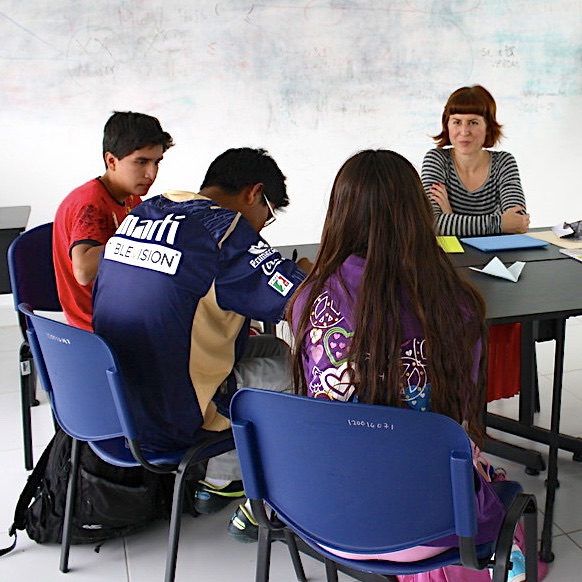
I learned the value of working collaboratively to make work. During my first residency I worked with a group of secondary school students to make relief prints and develop an exhibition of work. I found that working with others, rather than on my own, was more engaging and purposeful and I felt that the final work was greater than what could be achieved when working solo. I also just really liked making work that wasn’t about myself. Since then I have devoted my time to a collaborative project with a small group of women, wherein we sought to document the experiences of women artists working today. I left the project to focus on parenthood, but the project is still ongoing. (The website for the project is favoureconomy.com). It feels right that a socially engaged project should continue to develop and have life, though the individuals working on the project might come and go.
How are artist residencies important to the artistic practice?
Muy importante! They give an artist the opportunity to focus on their practice and to broaden their artistic thinking through cultural exchange and conversation.
What is your artistic practice?
I am an abstract artist devoted to exploring the theme of cultural duality in my work. My work also explores themes of universality, peace, love, purity, process, mystery, and beauty. My paintings are largely inspired and influenced by music, which I believe spans our differences and connects us across race, religion, ethnicity, and culture.
On what projects are you currently working?
I am working on smaller abstracts on paper using acrylic, ink, and gold leaf foil. I’m also in the process of moving into my first studio space that will be shared with up to three other artists. We’re creating a space where everyone is welcome and we plan to host monthly workshops, open studios, and other various events.
What is the most relevant conversation that you remember having during your residency at Arquetopia?
I have to preface this question by saying that all of my conversations at Arquetopia were profound. I have never been in a space where everyone is so vulnerable and open to sharing their creative process. It was so refreshing to be surrounded by people who shared their perspectives on all aspects of life, and did so unapologetically and articulately. However, the one conversation that was most relevant to me was a meeting with Nayeli and Francisco where I was asked why I repeat certain patterns in my work. It was such a simple question, but I didn’t have an answer. I have always been aware of the patterns in my work, but I have never asked myself why I create those patterns. Francisco then prompted me to seek the reasons and take detailed notes while I’m creating. That one conversation completely changed how I work.
What changed after your residency at Arquetopia?
My creative process has changed a lot and I’ve become more confident and open-minded. I used to zone-out while painting, but now I have become more mindful of the movements that I make and the thoughts that I think. I became more confident in myself as a woman (of cultural duality) and I started to change the language that I use, such as replacing “I feel… ” with “I think… ” when expressing myself. I also started a new practice of journaling about my work, which has helped me to understand myself better. As an abstract artist, I want my work to speak for itself, but I’ve realized how important it is for me to communicate my thoughts through language as well. This practice of being more mindful and asking myself questions as I create has helped me communicate better, which was my ultimate goal for the residency.
How are artist residencies important to the artistic practice?
I broke open at Arquetopia… it was truly a life-changing experience. Residency programs are important to the artistic practice because, as artists, we are all on a journey of seeking truth, and residency programs help us get closer to the truth. They help us get closer to the truth by creating the space to be vulnerable and ask the big questions and see things from a different perspective. At Arquetopia, I was surrounded by like-minded people who were talented and intelligent and passionate. Arquetopia did a great job of curating who shared the space and I appreciated their selection process. Nothing compares to the energy you create when you’re doing something with passion and honesty. It fills you up and you radiate inspiration. This was the energy I was surrounded by all the time at Arquetopia, and it’s why it was so easy to break open.